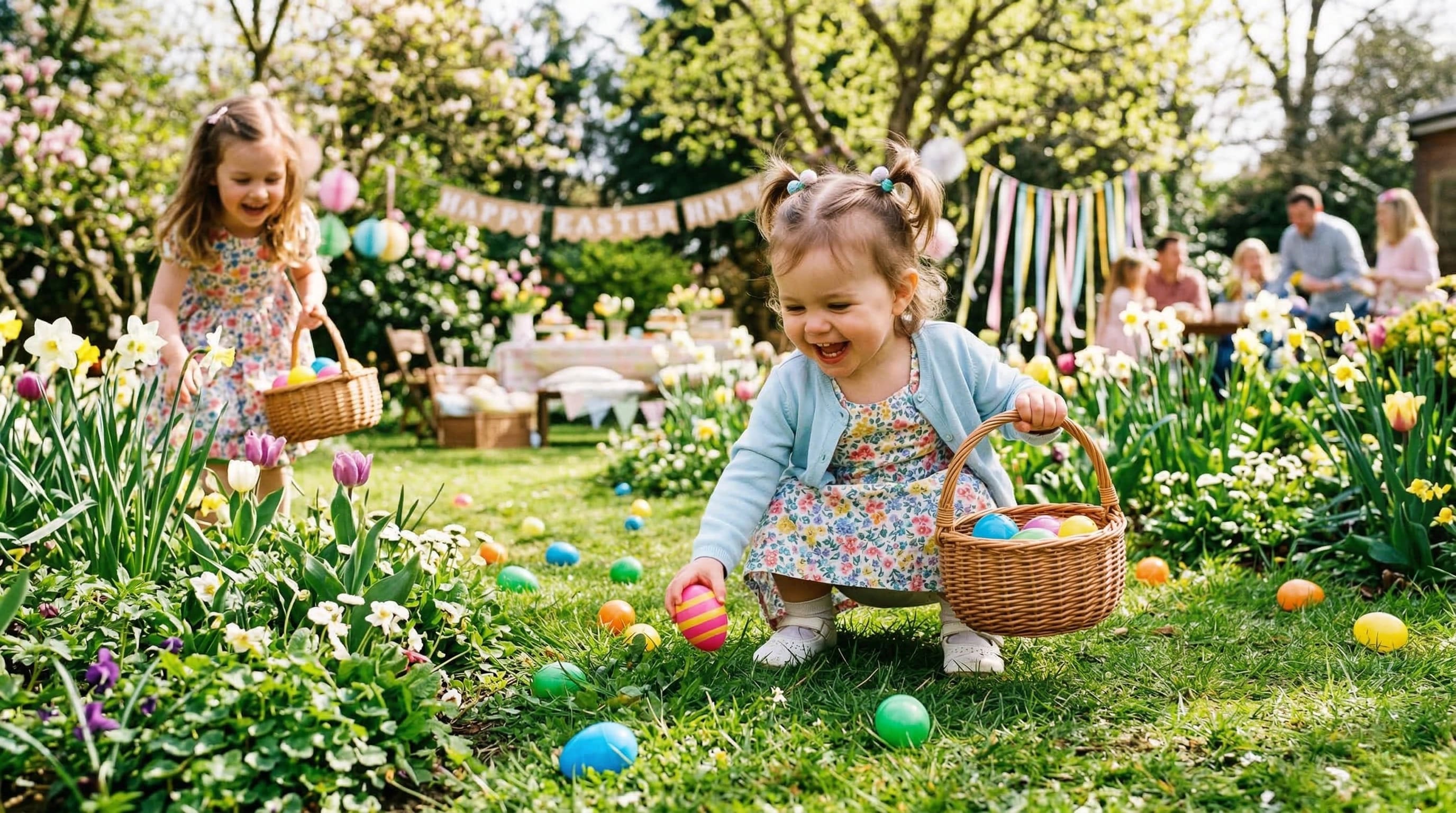
15 Creative Easter Egg Hunt Ideas for Toddlers & Young Kids
Planning an Easter egg hunt for toddlers can feel like walking a tightrope. Too challenging and you'll have crying 3-year-olds. Too easy and the 7-year-olds complain they're bored. This guide gives you 15 proven Easter egg hunt ideas specifically designed for toddlers (ages 2-4) and young children (ages 5-8) that keep everyone happy and engaged.
With Easter Sunday 2026 falling on April 20th, you have plenty of time to plan the perfect age-appropriate hunt that creates joyful memories instead of frustrated tears.
Why Age-Appropriate Easter Hunts Actually Matter
A 3-year-old and an 8-year-old have completely different cognitive and physical abilities. When you mix them in the same hunt without adjustments, here's what typically happens:
The common scenario: The 8-year-old grabs all the eggs in 47 seconds while the 3-year-old stands frozen, finds only two eggs, then dissolves into tears. Parents scramble to redistribute eggs while everyone ends up unhappy.
The solution: Age-appropriate hunts with thoughtful rules ensure every child experiences success, builds confidence, and genuinely enjoys the activity. Research shows that successful early holiday experiences create positive associations that last into adulthood.
Easter Egg Hunt Ideas for Toddlers (Ages 2-4)
Toddlers need simple, successful experiences where the goal is participation and joy—not competition or challenge.
How Many Eggs for Toddlers?
6-10 eggs per child, all placed in plain sight at their eye level or below. Keep hunt duration to 5-10 minutes maximum.
1. The Rainbow Color Hunt
How it works: Assign each toddler a specific color to find. Emma hunts for all red eggs, Jack collects all blue eggs, and Sophie gathers all yellow eggs.
Why toddlers love it:
- Simple, clear rules they can understand
- No competition between children
- Reinforces color recognition skills
- Every child feels special hunting "their" color
Setup tips:
- Use 6-8 eggs per color
- Place eggs in obvious spots: on chair seats, next to flower pots, on porch steps
- Keep everything at toddler height (2-3 feet maximum)
- Give each child a basket with a ribbon matching their assigned color
Safety note: Ensure all eggs are large enough to avoid choking hazards (minimum 2.5 inches diameter).
Time: 5-10 minutes
2. The Trail Hunt
How it works: Create an obvious trail of eggs spaced 2-3 feet apart, leading to a "grand prize" basket at the end.
Why it works for toddlers: They can easily spot the next egg, building anticipation with each discovery. Everyone reaches the finish line successfully—guaranteed smiles.
Enhanced variations:
- Use sidewalk chalk to draw arrows between eggs
- Create a yarn or string trail they can follow
- Add footprint cutouts leading the way
- Make the "grand prize" something exciting (bunny plush, sticker book, small toy)
Accessibility tip: This format works perfectly for children using mobility aids—just ensure the path is wide and clear.
Time: 5-10 minutes
3. The Helper Hunt
How it works: Pair each toddler with an older sibling or adult "helper" who provides warm/cold hints but never touches the eggs.
Why toddlers love it: They receive special one-on-one attention and experience success without frustration.
Expert guidance:
- Helpers give verbal clues only: "Getting warmer!" or "Look near the blue chair"
- Never let helpers touch or point directly at eggs
- This keeps toddlers actively engaged and learning spatial concepts
Perfect for: Mixed-age gatherings where older kids (8+) can take leadership roles.
Time: 10-15 minutes
4. The Musical Eggs Hunt
How it works: Play music while toddlers search. When the music stops, everyone freezes and shows what they've found. Count eggs together, celebrate, then resume hunting.
Educational benefits:
- Teaches self-regulation and impulse control
- Practices following multi-step directions
- Frequent pauses let slower hunters catch up naturally
- Combines movement with music (enhances memory formation)
Music suggestions: Upbeat, age-appropriate songs like "If You're Happy and You Know It" or "The Bunny Hop."
Time: 10-15 minutes
5. The Basket Swap
How it works: Every 2-3 minutes, call "Basket swap!" and kids trade baskets with another child, then continue hunting.
Why parents love this:
- Eliminates hoarding behavior completely
- Prevents crying over "who got more"
- Everyone ends up with similar amounts because baskets circulate
- Teaches sharing and cooperation
How it ends: Each child keeps whichever basket they're holding at the final whistle.
Pro tip: Set a timer on your phone so swaps happen at consistent intervals.
Time: 10-15 minutes
6. The "Eggs in Plain Sight" Hunt
How it works: Every single egg is completely visible—no hiding whatsoever. Just place them around the yard or room in obvious spots.
Why it works for 2-year-olds: They're still developing the concept of "searching." Obvious eggs equal instant success, building confidence and positive associations with the activity.
Smart placement ideas:
- On the bottom step of stairs
- In the middle of the sidewalk
- On chair seats (pushed in so they're visible)
- Next to large flower pots
- In their toy wagon or sandbox
Time: 5 minutes
Easter Egg Hunt Ideas for Young Kids (Ages 5-8)
Children in this age range can handle moderate challenge and love hunts with themes, rules, and mild competition.
How Many Eggs for Ages 5-8?
12-20 eggs per child with moderate hiding difficulty. Hunt duration: 15-25 minutes.
7. The Glow-in-the-Dark Hunt
How it works: Use glow-in-the-dark eggs or insert glow sticks inside regular plastic eggs. Hunt after sunset with flashlights.
Why kids love it: Hunting in the dark transforms the familiar backyard into a mysterious adventure. The novelty makes even simple hiding spots feel exciting.
Safety requirements:
- Clear the hunt area of tripping hazards beforehand
- Set clear, visible boundaries with rope or stakes
- Works great in fenced backyards or inside a darkened house
- Adult supervision mandatory; assign one adult per 4-5 children
Age-appropriate timing: Start around 7:30-8:00 PM (still light enough to be safe, dark enough to be fun).
Time: 15-20 minutes
8. The Scavenger Hunt Hybrid
How it works: Instead of finding eggs directly, kids find clue cards leading to the next location. Each spot has an egg plus another clue.
Sample clue progression for 6-year-olds:
- Start clue: "Where we keep our car" → Garage
- Garage clue: "Where flowers grow" → Garden
- Garden clue: "Where we wash our hands" → Bathroom
- Bathroom clue: "Where milk lives" → Refrigerator
- Final prize at last location
Educational bonus:
- Practices reading comprehension
- Develops logical thinking skills
- Builds spatial awareness
- Encourages problem-solving
Differentiation tip: For emerging readers, use picture clues instead of words.
Time: 20-30 minutes
9. The Golden Egg Challenge
How it works: Hide one special "golden" egg (spray-painted gold or wrapped in gold foil) among regular eggs. The child who finds it wins a special prize.
Keeping it fair:
- Hide the golden egg in a moderately difficult spot—not the hardest or easiest
- This gives every child a realistic chance
- Consider hiding 3-5 golden eggs so multiple kids can win
Prize ideas that work:
- Extra piece of special candy
- Small toy from the dollar store
- "Stay up 15 minutes late" coupon
- Extra turn on the family swing
- Choose tonight's movie privilege
Time: 15-20 minutes
10. The Puzzle Piece Hunt
How it works: Place puzzle pieces inside plastic eggs. Kids must find all eggs, then work together to complete the puzzle revealing a surprise message.
Setup instructions:
- Use a 12-24 piece puzzle (age-appropriate complexity)
- Hide 12 eggs, each containing 1-2 pieces
- Kids must find all eggs to complete the puzzle
Cooperative twist: This transforms competition into collaboration—everyone wins when the puzzle is complete.
What the puzzle can reveal:
- "Your prize is in the garage!"
- "Ice cream time at 3 PM!"
- A picture of their Easter gift
- "Great job, team! You did it!"
Time: 20-25 minutes
11. The Color-Coded Prize Hunt
How it works: Different egg colors equal different point values. Kids strategize whether to grab many easy eggs or search longer for high-value eggs.
Point system example:
- Pink eggs = 1 point each
- Blue eggs = 2 points each
- Green eggs = 3 points each
- Golden egg = 10 points
Why it works:
- Introduces basic math and addition
- Encourages strategic decision-making
- Competitive kids love maximizing scores
- Less competitive kids can still succeed
Variation: Exchange points for small prizes at different tiers (10 points = sticker, 20 points = small toy).
Time: 15-20 minutes
12. The Backwards Hunt
How it works: Kids HIDE the eggs instead of finding them! Divide into two teams. Team A hides eggs for Team B, then they switch roles.
Why kids love it:
- They get double the fun—hiding is just as exciting as hunting
- Develops empathy (understanding difficulty from other perspective)
- Practices following rules about "fair" hiding spots
Parent bonus: Twice the entertainment value from the same eggs.
Ground rules:
- Eggs must be visible from at least one angle
- No hiding in off-limit areas
- 5-minute time limit for hiding
Time: 30-40 minutes total (15-20 minutes per round)
13. The Indoor Apartment Hunt
How it works: Perfect for small spaces or bad weather. Hide mini eggs or foil-wrapped candies in creative indoor spots.
Creative apartment hiding spots:
- Inside shoes by the front door
- In jacket pockets hanging in closets
- Between couch cushions
- Inside coffee mugs in the cabinet
- In the silverware drawer (clean section)
- Between book pages on shelves
- Behind picture frames
- In the medicine cabinet (on designated child-safe shelf)
Small space strategy:
- Fewer eggs but more creative hiding = maintains challenge
- Vertical space is your friend
- Quality of hiding spots matters more than quantity
Time: 15-20 minutes
14. The Beeping Egg Hunt
How it works: Use eggs that beep, light up, or make noise when you press a button.
Perfect for:
- Children with visual impairments
- Low-light hunting conditions
- Adding sensory variety to traditional hunts
- Teaching cause-and-effect
Where to find: Electronic beeping eggs available online (Amazon, Target), or DIY by placing small electronic devices inside regular eggs.
Accessibility bonus: This format ensures children with different abilities can participate fully and independently.
Time: 15-20 minutes
15. The Photo Clue Hunt
How it works: Instead of written clues, kids receive photos showing where eggs are hidden. They must recognize locations from the photographs.
How to create effective photo clues:
- Take close-up or unusual-angle photos of hiding spots
- Print or display on tablet
- Make them challenging but solvable
Example photo clues:
- Extreme close-up of fence slat pattern → egg behind fence
- Upward angle of tree branch → egg in tree
- Ground-level shot of chair legs → egg under chair
- Close-up of flower petals → egg in flower pot
Brain workout benefits:
- Visual recognition skills
- Spatial reasoning
- Problem-solving under time pressure
Time: 20-30 minutes
Making Easter Egg Hunts Fair for Mixed Ages
When you have both toddlers and 5-8 year olds hunting together, use these proven strategies:
Strategy 1: Color-Coding by Age
- Toddlers (2-4): Hunt pink and yellow eggs only
- Young kids (5-8): Hunt blue and green eggs only
- Everyone has equal opportunity without direct competition
Strategy 2: Staggered Start Times
- Give toddlers a 3-minute head start
- Older kids join after
- Naturally levels the playing field
Strategy 3: Individual Egg Limits
- Set maximum per child: "Find 10 eggs, then help others"
- Once kids hit their limit, they become helpers or cheerleaders
- Prevents hoarding and encourages cooperation
Strategy 4: Separate Physical Zones
- Toddler zone: Front yard with easy eggs at low height
- Older kids zone: Backyard with moderate-difficulty hiding
- No overlap, no conflict, everyone succeeds
What to Put Inside Easter Eggs (Beyond Candy)
For Toddlers (Ages 2-4):
- Stickers (animals, characters)
- Small cars or figurines (check for choking hazards)
- Temporary tattoos
- Mini bubble bottles
- Coins for piggy bank (quarters feel special)
- Cheerios or goldfish crackers (mess-free snack option)
For Ages 5-8:
- Money ($1-2 bills folded small)
- Small LEGO pieces or mini sets
- Trading cards (Pokémon, sports)
- Jokes printed on paper (builds reading skills)
- Hair accessories (scrunchies, clips)
- Fun erasers or pencils
- Privilege coupons ("Pick tonight's movie," "Stay up 15 min late")
Allergy-Friendly Options:
- Play-Doh mini containers
- Silly putty
- Mini notepads
- Crayons or colored pencils
- Rubber stamps
Expert tip: Mix candy with non-candy items at a 50/50 ratio to reduce sugar intake while maintaining excitement.
Safety Checklist for Young Kids' Easter Egg Hunts
Before the hunt starts:
- ✓ Check entire yard for dog waste, sharp objects, or hazards
- ✓ Remove eggs from direct sunlight if containing chocolate (melts in 15-20 minutes on warm days)
- ✓ Keep master list of hiding spots (you WILL forget some)
- ✓ Set and communicate clear physical boundaries
- ✓ Have allergy-safe options available for children with food allergies
- ✓ Assign supervising adults to different zones
Choking hazard awareness for toddlers:
- ✗ Avoid toys smaller than 1.25 inches (toilet paper tube test)
- ✗ Skip hard candies for children under 4
- ✓ Check all items against age recommendations on packaging
How Long Should the Hunt Actually Last?
Ages 2-4 (Toddlers): 5-10 minutes maximum
- Toddler attention span is developmentally short
- Success comes from finding eggs quickly, not prolonged searching
Ages 5-8 (Young kids): 15-25 minutes optimal
- Can sustain focused attention longer
- Enjoy both the challenge and the process
Universal rule: If your hunt ends in under 5 minutes total, you either didn't hide eggs well enough or didn't use enough eggs.
Easter Egg Hunt Timeline for Success
Two Days Before Easter (Friday, April 18):
- Buy eggs and filler items
- Test that all plastic eggs close securely
- Walk through hunt area and plan hiding spots
Day Before Easter (Saturday, April 19):
- Fill all eggs with chosen items
- Create any clue cards or special elements
- Brief helpers or older siblings on their roles
- Store filled eggs in cool, dry place
Easter Morning (Sunday, April 20):
- Hide eggs 30-60 minutes before scheduled hunt time
- Do final safety walkthrough
- Gather children and explain rules clearly
- Take photos—these become precious memories!
Final Expert Tips for Successful Hunts
Do these things:
- ✓ Match difficulty precisely to age and ability
- ✓ Have 10-20% more eggs than needed (you'll lose some behind bushes)
- ✓ Take lots of photos and videos
- ✓ Celebrate every child's success verbally
- ✓ Keep the entire event short and sweet
Avoid these mistakes:
- ✗ Making it overly competitive between children
- ✗ Forgetting to check for food allergies
- ✗ Hiding eggs too cleverly (finding them in July isn't fun)
- ✗ Stressing about perfection
- ✗ Comparing children's hauls or abilities
FAQ
Q: How many Easter eggs should I hide for a 3-year-old?
A: Hide 6-10 eggs for a 3-year-old, all placed in plain sight at their eye level or below. Position them in obvious spots like on chair seats, next to toys, or on porch steps. Toddlers need easy success rather than challenge—this builds confidence and positive associations with the activity.
Q: What age is appropriate for Easter egg hunts?
A: Easter egg hunts work well for children ages 2 and up. For 2-4 year olds, keep eggs visible and easy to find with simple rules. Children ages 5-8 can handle hidden eggs, basic clues, and mild competition. Always adjust difficulty to match individual child development rather than age alone.
Q: How do you make an Easter egg hunt fair for different ages?
A: Make multi-age hunts fair by using color-coding (different ages hunt different egg colors), giving younger children a 2-3 minute head start, setting per-child egg limits, or creating separate physical zones for different age groups. The goal is ensuring every child finds eggs and experiences success.
Q: What can I put in Easter eggs besides candy?
A: Non-candy Easter egg fillers include: stickers, small toys, temporary tattoos, coins, dollar bills, bubbles (for toddlers), small LEGO pieces, trading cards, jokes on paper, hair accessories, or privilege coupons like "pick tonight's movie" (for older kids). Mixing 50% candy with 50% non-candy items reduces sugar while maintaining excitement.
Q: How long should a toddler Easter egg hunt last?
A: Toddler Easter egg hunts should last 5-10 minutes maximum. Children ages 2-4 have developmentally short attention spans and derive more joy from finding eggs quickly than from prolonged searching. If your hunt ends in under 5 minutes, you need more eggs or better hiding spots.
Q: Are glow-in-the-dark Easter egg hunts safe for young kids?
A: Yes, glow-in-the-dark hunts are safe for children 5+ when properly supervised. Requirements include: clearing the area of tripping hazards beforehand, setting visible boundaries, ensuring adult supervision (1 adult per 4-5 kids), and hunting in familiar spaces. For children under 5, stick to indoor hunts or well-lit outdoor areas.